
Karnes County Release Date Types
One date cannot answer every release question. TDCJ uses Projected Release Date for a current state prisoner. The calculation may point to mandatory supervision or, when that route is unavailable or not approved, to discharge. A Parole Eligibility Date only marks the first point at which a case can qualify for Board review under the applicable rule. It is not a promised release.
TDCJ also describes a later Scheduled Release Date and Scheduled Release Location. Classification and Records calculates that information after receiving a release certificate and auditing the file. Even then, TDCJ warns that a scheduled date can change without notice, including on the scheduled day. The evidence ladder is projection, scheduled processing, then the actual recorded event.
| Date or status | What it means |
|---|---|
| Projected release date | A current TDCJ calculation based on the governing release path and record. |
| Parole eligibility date | The point at which Board review may become available, not an approval. |
| Maximum sentence date | The sentence endpoint shown in the current record, subject to lawful changes. |
| Scheduled release date | A later processing date calculated after a release certificate and audit. |
| Actual release date | The completed departure event held in the agency’s historical record. |
Find a Karnes County Release Date
First identify whether the person is in Karnes County Jail, John B. Connally Unit, another TDCJ prison, the USMS-contract detention facility, or ICE custody. Facility names are crucial in Karnes County because four separate systems operate locally. A county booking number does not work in TDCJ. A TDCJ projected date does not describe a federal or immigration detainee.
- Confirm the full name with date of birth and an agency number, such as a booking, TDCJ, SID, case, BOP, or A-number.
- For current TDCJ imprisonment, search by TDCJ or SID number when possible. Read Projected Release Date, Parole Eligibility Date, Maximum Sentence Date, and current unit as separate fields.
- For Karnes County Jail, ask the sheriff whether the person is pretrial or sentenced and request the booking/release record. Check the related court order and jail-time credit.
- For a federal pretrial detainee, inspect the federal docket and responsible USMS route. Use BOP only after commitment to federal prison.
- For ICE detention, use ODLS for present custody, then contact ICE or the facility. ODLS is not a release-date calendar.
- Recheck after the expected date and obtain the actual event from the agency that held the person.
The Karnes County released inmate search provides the full records-request and court cross-check path for a person who has already left custody.
TDCJ Release Date Search Fields
The TDCJ Inmate Information Search is authoritative for people currently confined in TDCJ facilities. It accepts name fields, TDCJ number, SID, gender, and race. Numbers are the strongest search keys. If searching by name, compare age, race, gender, conviction county, offense, and sentence data before attributing the result.
| Field | Use | Limit |
|---|---|---|
| TDCJ or SID number | Direct identifier for the state record | Must match the person |
| Name | Starting point when no number is known | Common names can collide |
| Current facility | Shows present TDCJ placement | A transfer is not release |
| Projected release | Prospective TDCJ calculation | Can change and is not the event |
| Parole eligibility | Possible review timing | Does not guarantee a favorable vote |
| Maximum sentence | Sentence endpoint field | Read with the full official record |
TDCJ limits this public search to current prisoners. A former state prisoner may no longer return a result. Use TDCJ offender-information channels or the public-information process for the actual historical release or discharge. Use the Parole Division when community supervision continues.
The official TDCJ search form is captured in the successful Karnes County image manifest.
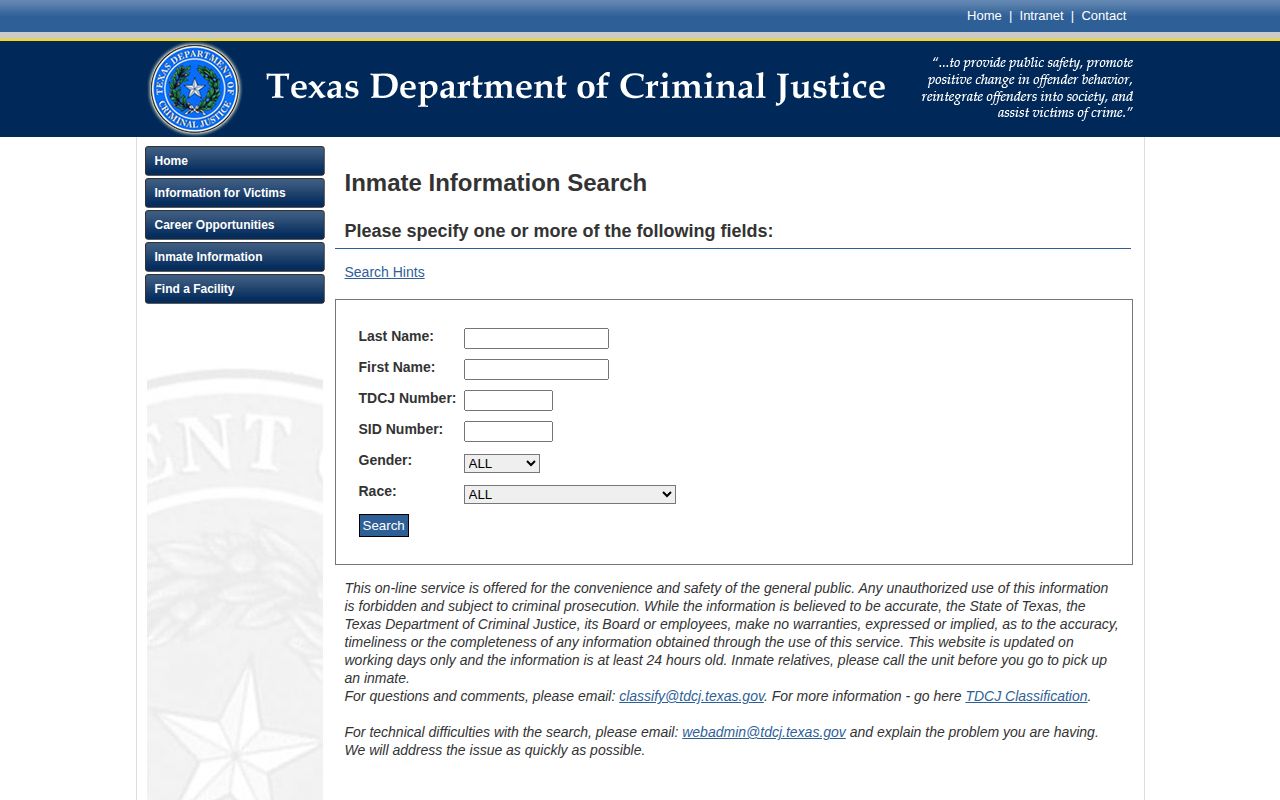
The form shows why identifiers and narrowing fields start a state-prison lookup before a projection is interpreted.
Karnes County Jail Date Limits
A pretrial detainee generally has no sentence-based projected release date. Departure may depend on bond, a court order, dismissal, transfer, extradition, or another agency’s hold. The Karnes County Sheriff record identifies the physical event. The County or District Clerk file can explain its legal basis, but a court docket timestamp is not always the moment the person left the jail.
For a county sentence, ask for the judgment, sentence, jail-time credit, and booking/release history. Do not apply TDCJ formulas to Karnes County Jail. The research found no official Karnes County page publishing a county-jail good-time schedule, weekend-release rule, or local formula. An unsupported arithmetic estimate can be wrong even when the sentence length is known.
Call the Karnes County Sheriff at 830-780-3931 with the full name, date of birth, booking number if known, and approximate custody dates. If a durable copy is needed, request the booking sheet or jail card, charge and bond entries, release date and time, and release type or destination under the Texas Public Information Act.
Note: A future court date for a released defendant reflects the open case and does not mean the person remains in jail.
Texas Good Time and Release
Texas Government Code chapter 498 governs TDCJ good-conduct time. Section 498.003 ties credits to classification and participation, calls good time a privilege rather than a right, and applies it to parole or mandatory-supervision eligibility. Good time does not otherwise shorten the imposed sentence. Credits may be forfeited, restored, or recalculated, so subtracting a standard amount from a sentence is not a valid release-date method.
Mandatory supervision generally considers calendar time plus accrued good time, but Government Code sections 508.147 through 508.149 contain exclusions and discretionary findings. For offenses on or after September 1, 1996, Board approval can matter. Offense date, conviction offense, sentence, prior law, credit record, and Board decision all affect the outcome.
Texas does not impose a universal 85 percent rule on every state prisoner. For many serious offenses listed in Code of Criminal Procedure article 42A.054, or cases with an affirmative deadly-weapon finding, section 508.145(d) generally sets parole eligibility at actual calendar time equal to one-half of the sentence or 30 years, whichever is less, with at least two calendar years served. Other subsections have different rules. Eligibility still does not compel release.
Why Karnes County Dates Change
A projected or scheduled release date is built from a living legal and agency record. An amended judgment can change the sentence. A jail-credit audit can correct time already served. TDCJ can revise credit calculations. A new detainer can send a person to another custodian instead of the community. Board action, a required program, disciplinary action, or an incomplete release plan may also affect timing.
| Change | Possible effect |
|---|---|
| Amended judgment | Changes the controlling sentence or terms |
| Jail-credit recalculation | Adds or corrects credited custody time |
| Good-time loss or restoration | Changes eligibility calculations where credits apply |
| Parole or mandatory-supervision decision | Approves, denies, conditions, or delays a release path |
| Detainer or new sentence | May cause transfer rather than community release |
| Program or release-plan issue | Can affect processing after a favorable decision |
| Final records audit | May revise scheduled information before departure |
For a release notification near the expected date, the Karnes County VINE inmate check explains the current IVSS-Counties and TDCJ IVSS split. Treat the alert as a cue to verify, not as the final discharge paper.
Connally Unit Release Processing
John B. Connally Unit is a TDCJ state prison in Karnes County, not the county jail. Its official profile uses unit code CY. A move from Connally to another TDCJ unit is a transfer and leaves the person imprisoned. The current TDCJ result should show the new facility after the system updates.
The official unit directory lists CHANGES/Pre-Release programming, but a prerelease program does not set the legal release date. Nor does residence at Connally make Karnes County courts responsible for the prisoner’s underlying statewide sentence. TDCJ Classification and Records, the Board when parole or mandatory supervision applies, and the central historical record control the state release conclusion.
Before an expected departure, save the official identifiers and each labeled date. Afterward, check whether TDCJ still reports current incarceration, then request the actual release mechanism, release date, and discharge status from the appropriate TDCJ channel. If parole follows, verify it through the Parole Division. This before-and-after method preserves context without treating disappearance from a live search as proof.
Karnes County Actual Release Record
Keep a dated copy or note of each official result used in the sequence. A projection captured before release and an agency record produced afterward answer different questions. Recording the label, lookup date, identifier, and source makes later changes understandable without claiming that the earlier calculation was the completed event.
The last step is retrospective confirmation. For Karnes County Jail, obtain the sheriff’s release event and compare it with the court disposition or order. For TDCJ, obtain the historical release or discharge information and check supervision status. For a federal case, use the court order and USMS or BOP record. For immigration custody, distinguish release, transfer, and removal through ICE and the facility.
Record the exact agency language. “Released,” “paroled,” “mandatory supervision,” “discharged,” and “transferred” are not synonyms. A person can leave one building while remaining in government custody. The actual release record should name the custodian, event date, and mechanism clearly enough to avoid that error.
Texas public-record access is governed by Government Code chapter 552, with exceptions and special rules for law-enforcement and TDCJ records. Ask for narrow fields and strong identifiers. If systems disagree, contact the office that created the record rather than choosing the date that fits an expectation.
A useful historical request names the person, agency number, date range, releasing facility, actual release date, release mechanism, and discharge date if one exists. The custodian may apply statutory limits, but a focused request separates the completed event from projections and later supervision.