
KCIPC Detainee Release Outcomes
Karnes County Immigration Processing Center, or KCIPC, is operated by GEO Group for ICE at 409 FM 1144. It is not Karnes County Jail, Connally Unit, or the Commerce Street USMS facility. Immigration detention is civil. County booking records and the TDCJ offender search are therefore the wrong starting points for this population.
Departure can mean conditional release, transfer to another ICE site, handoff to another authority, or removal from the United States. Removal ends detention in this country but is not release into the Karnes community. A person released from ICE detention may still have check-ins, an immigration court case, electronic monitoring, or other conditions. The release papers and ERO record provide the needed context.
Confirm KCIPC Detainee Release
The ICE Online Detainee Locator System, known as ODLS, is the first public search. Search with a nine-digit A-number and country of birth, padding leading zeros when needed. The alternative route uses exact first and last name plus country of birth, with date of birth as an optional filter. Exact matching matters.
ICE materials state that ODLS covers current detainees and, in attorney resources, people released from ICE custody within the prior 60 days. Children under 18 do not appear. Some records may be omitted for security, safety, or discretionary reasons, and uploads may lag. The Karnes County custody and release overview helps separate KCIPC from the other local facilities.
- Search ODLS by A-number and country of birth when the identifier is known.
- Try exact biographical data if the A-number route is unavailable.
- Save the exact result wording and lookup time; do not treat a blank screen as an event record.
- Call KCIPC when the result may reflect lag or a move from the building.
- Contact ICE ERO or the ICE information line to distinguish release, transfer, and removal.
- Use the person's departure paperwork and immigration court sources for conditions and later proceedings.
Note: ICE's locator brochure warns that facility data may be up to eight hours old, so urgent questions require direct confirmation.
KCIPC Locator Result Limits
An ODLS “not in custody” result means the person is not displayed as currently detained by ICE. It does not identify the legal outcome. A no-result is weaker because a spelling difference, identifier issue, exclusion, upload lag, minor status, or expiration of the recent-release window can cause it.
| ODLS situation | Next step |
|---|---|
| Current facility shown | Confirm identity, then contact the listed facility as needed |
| Not in custody | Ask ERO whether the event was release, transfer beyond scope, or removal |
| No exact match | Recheck A-number, spelling, country of birth, and date of birth |
| Recent departure | Allow for feed lag and call KCIPC |
| Older event | Use ICE records and the person's papers rather than ODLS alone |
When a person was released under immigration conditions, ICE's check-in guide says the paperwork may or may not list the reporting date, location, and time. The assigned deportation officer or ERO office can clarify the next required contact. Immigration court records address the case, but should not be substituted for the custody event.
KCIPC Records and Contact
GEO publishes the processing center's address, phone, fax, capacity, and ICE client relationship. Facility staff are the best direct check for a very recent building departure. For broader immigration custody status or concerns, the ICE Detention Reporting and Information Line provides a separate route.
409 FM 1144
Karnes City, TX 78118
830-254-2000
Fax: 830-254-2294
1-888-351-4024
Monday through Friday, excluding holidays
8 a.m. to 8 p.m. Eastern
For a written immigration custody record, ICE FOIA may be appropriate. A person seeking their own A-file or release documentation must follow identity and consent requirements. State the A-number, full identity, approximate dates, facility name and alias, and the precise departure or custody record sought.
KCIPC Facility Capacity and Use
GEO lists capacity at 1,328. A 2026 PREA audit reported 10,785 bookings in the preceding twelve months, average custody of 26 days, and 1,242 people onsite on the first audit day. These are operational figures for the ICE processing center. They are not Karnes County Jail bookings or releases and must not be combined with sheriff statistics.
Review the GEO KCIPC facility profile represented in the captured source.
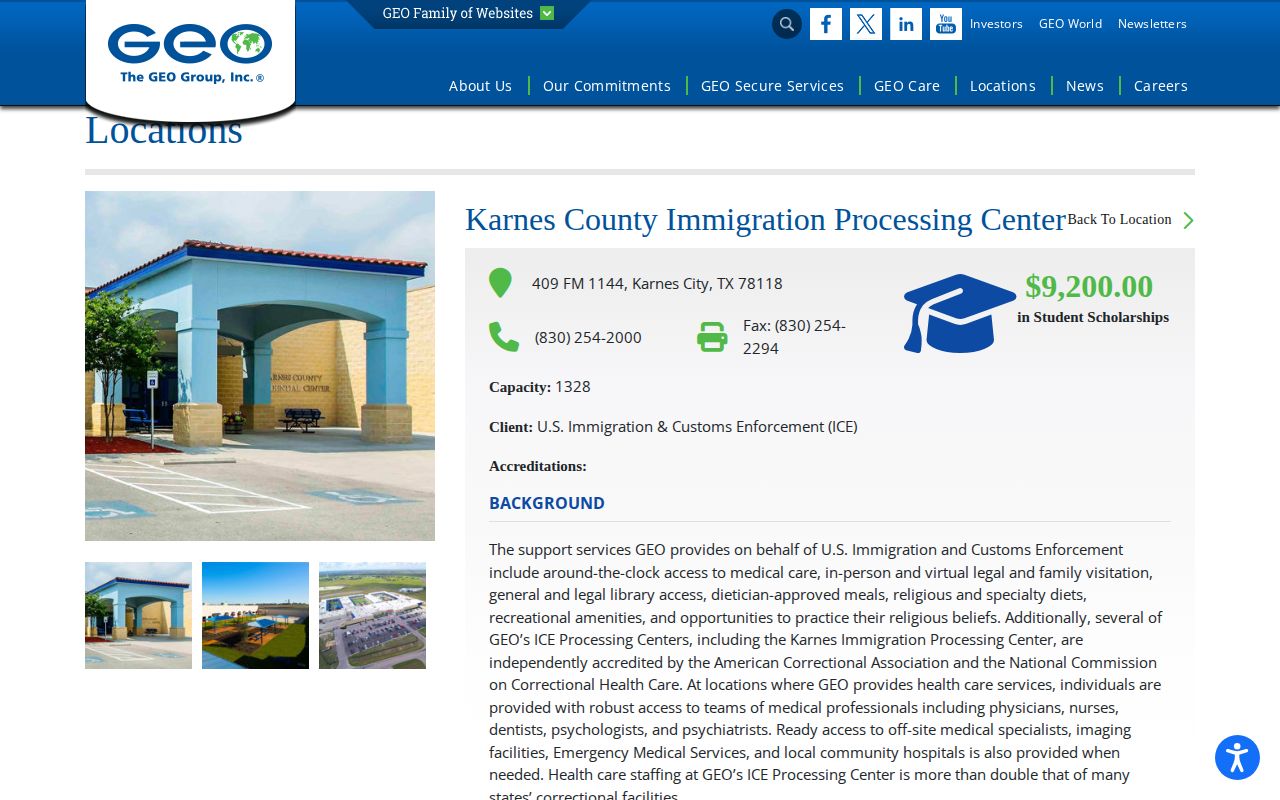
The profile confirms the current facility name, operator, ICE client, capacity, address, and contact. A person's release outcome still requires ODLS, ERO, or departure records.
KCIPC Property After Release
ICE's National Detainee Handbook says personal property is receipted at intake and returned upon release. It also says personal and legal identity documents are returned when the case is resolved. A person leaving KCIPC should retain the intake receipt, check the returned items, and keep all departure paperwork.
Property return is useful release logistics, but it does not identify the legal outcome. The same physical handoff can accompany conditional release, transfer, or removal. If property or identity documents are missing, raise the discrepancy promptly with the facility and preserve copies or photographs of the receipt. For the custody result, read the departure document and confirm with ICE.
KCIPC Names Through Time
The site opened in 2012 as a civil detention center and later operated as the Karnes County Residential Center. After an October 2022 standards and mission shift, the facility formally became the Karnes County Immigration Processing Center. Older government and case records may also use “family residential center.” Search those aliases when tracing an older detention episode.
GEO reported a short family-unit mission for about three weeks in March 2025 before ICE continued single-adult use based on operational needs. Facility mission can change. Dated descriptions should not be treated as current proof of whom the center holds, and the live ICE facility route should control. Naming changes describe the same FM 1144 site rather than three current facilities.
KCIPC and Federal Custody Differences
Karnes City has two GEO federal facilities with names that can be confused. The Commerce Street Karnes County Detention Facility has a published capacity of 679 and serves USMS. KCIPC on FM 1144 has a published capacity of 1,328 and serves ICE. Neither is the KCSO jail.
A USMS federal defendant is verified through the court docket and marshal district, with BOP used after commitment to federal prison. An ICE detainee is checked through ODLS and ERO. Facility name and street address must come before any release claim. A result from BOP, PACER, the sheriff, or TDCJ cannot stand in for the KCIPC event unless another record documents an actual handoff to that system.
KCIPC Release Record Terms
Immigration custody terms describe different outcomes. Preserve the agency wording and avoid replacing it with a broad claim that the person “got out.”
- Conditional release
- Departure from detention with possible check-ins, monitoring, court duties, or other terms.
- Transfer
- Movement to another detention site or authority while custody continues.
- Removal
- Departure from the United States under immigration authority, not community release in Karnes County.
- A-number
- The immigration file identifier used by ODLS and many ICE records.
ODLS is a current and recent-status tool, not a discharge certificate. For older history or legal proof, retain the release papers and request the specific ICE record. If the result conflicts with a facility statement, ask ERO to reconcile the record dates.
KCIPC Departure Paper Check
Departure paperwork can resolve what ODLS cannot. Preserve the document title, A-number, issue date, custody action, reporting instructions, and named office. If a future check-in date is absent, that omission does not cancel all duties. Contact the assigned ERO office or deportation officer and ask which written instruction controls.
For a transfer, record the receiving site and check the current ICE locator after the normal update period. For removal, keep travel and agency documents distinct from community-release papers. If another authority assumed custody, use that authority's locator and record process. The goal is a clear chain from KCIPC departure to the next status, not an inference based on one missing search result.
Public Record Search
Sponsored Results