
Karnes Detention Facility Release Paths
Karnes County Detention Facility at 810 Commerce Street is operated by GEO Group for USMS. Despite its name, it is not the Karnes County Jail. The sheriff's custody page and county release record do not provide an authoritative list of this federal population. USMS holds federal prisoners from arrest through acquittal or commitment to the Bureau of Prisons and uses federal, local, and private beds across its network.
Leaving this building may mean a trip to federal court, airlift, a move to another USMS site, or designation to BOP after sentencing. Those are custody movements. A true pretrial release normally rests on a federal court order. An acquittal may also end the marshal hold, while another detainer can cause immediate transfer to a different authority. Confirm both the departure and its legal basis before describing it as release into the community.
Confirm Karnes Federal Release Records
USMS has no public historical inmate locator like the BOP system. Karnes County falls within the Western District of Texas, and the district's San Antonio office is the regional contact. For a federal defendant, PACER provides the electronic case docket, including filed detention and release orders. Access requires an account and may involve fees.
A careful lookup follows the person's custody stage. The Karnes County release search overview helps distinguish this federal facility from the nearby county, state, and ICE sites.
- Identify the exact facility and federal case. Do not substitute the sheriff's similarly named jail.
- Search PACER for the federal docket and read the latest detention, release, judgment, or commitment order.
- Contact the USMS Western District of Texas when current marshal custody or movement remains unclear.
- If the person was committed to BOP, search the BOP Inmate Locator by register number or exact identity.
- Use USMS FOIA for releasable custody history when the public docket does not supply the needed movement record.
Note: A federal court release order is stronger proof of pretrial release than a missing match at one contract detention site.
Karnes Detention BOP Record Check
BOP becomes relevant only if the person entered BOP custody. Its locator covers federal inmates released after 1982 and is updated daily. Search by BOP register number, DCDC, FBI, or INS number when known. A name search can also use age, race, and sex to narrow results. Compare identifiers rather than choosing a familiar name.
| BOP field | Meaning |
|---|---|
| RELEASED location | The person is no longer in BOP custody |
| Release date | End or expected end of the displayed BOP episode |
| IN TRANSIT | Movement, not proof of release |
| Community placement | May still count as BOP custody |
| Unknown date | BOP does not display a determined date |
A past BOP release date does not rule out supervised release or custody under another jurisdiction. “Supervised release” is a federal court term for monitoring in the community after imprisonment. It is distinct from physical BOP custody. For the legal conditions, consult the judgment and federal probation record rather than asking the Karnes contract facility.
Karnes Detention Facility Contact
GEO publishes the facility address, telephone, fax, capacity, and USMS client relationship. No public records-desk hours are documented in the research, so call before visiting. Facility staff may route a current operational question, but the federal court, USMS, or BOP remains the custodian for the corresponding federal record.
810 Commerce Street
Karnes City, TX 78118
830-780-3525
Fax: 830-780-4057
The USMS San Antonio office is at 262 W. Nueva Street, Room 2-300, San Antonio, with telephone 210-332-6800. For a documentary history, use the USMS Freedom of Information Act route and identify the person, case, approximate dates, and specific custody event sought. A focused request is easier to process than a demand for an entire file.
Karnes Detention Facility Profile
GEO lists a capacity of 679 and states that it assumed management in 1998. The facility was renovated in 1998 and 2006. Its services include federal court transport, airlift transport, and video conferencing for immigration court proceedings. Those functions help explain why a person can leave the building without leaving federal custody.
Review the GEO facility profile shown in this source image.
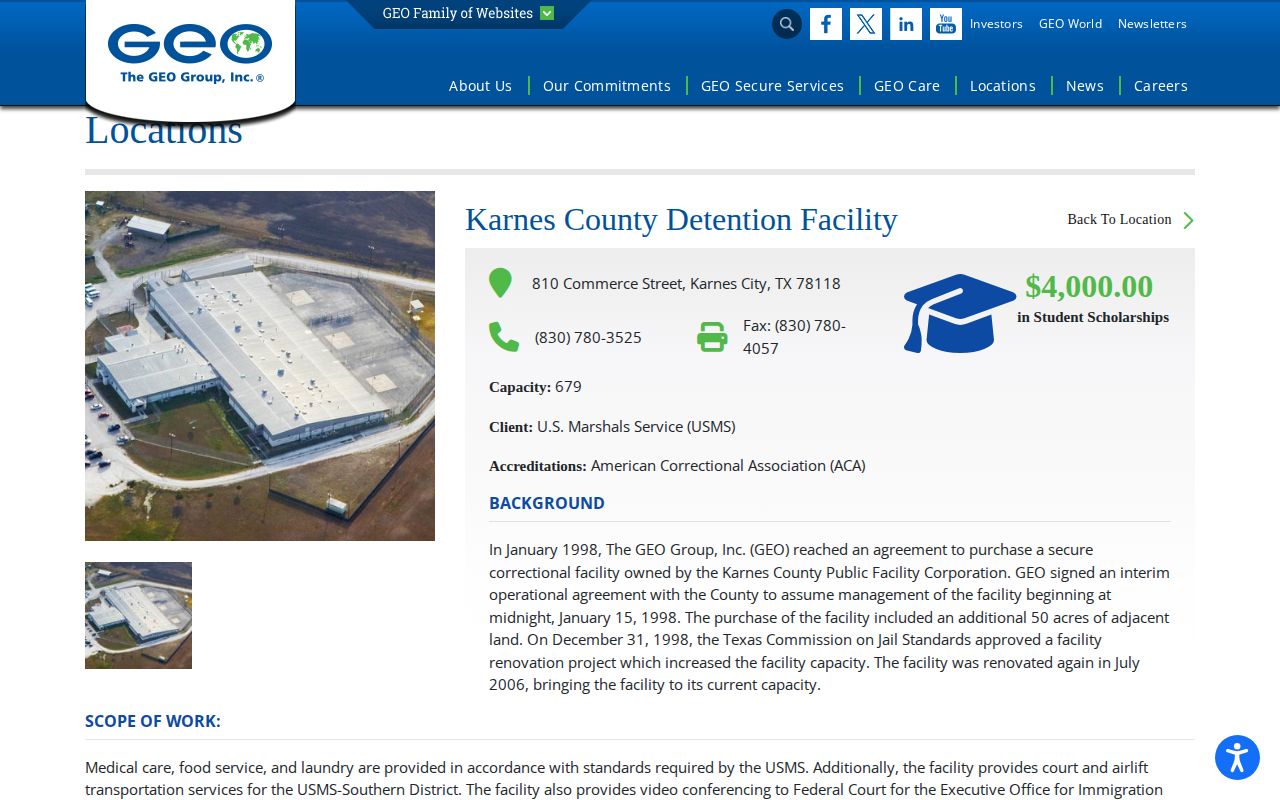
The profile establishes operator, client, location, and capacity. It does not replace a federal docket entry or agency custody record for one person.
Karnes Federal Detainers and Transfers
A detainer is a request or notice from another authority that can affect what happens when one custody basis ends. A person released from a federal court hold may still be delivered to a state, county, or immigration authority. Likewise, movement from 810 Commerce to BOP follows a federal commitment rather than community release.
The record sequence should name each handoff: facility departure, responsible marshal action, court order, and receiving agency. If ICE assumed custody, use ODLS and ICE ERO. If Texas assumed custody, use TDCJ or the relevant county. Do not use BOP's “RELEASED” label to claim that all government custody ended. BOP itself separates release from transfers to another jurisdiction.
Karnes Detention Facility History
Research angle L concerns local facility history, but the ICE center's 2012 opening and later residential-center names do not belong to this USMS site. The federal facility at Commerce Street has its own GEO management and renovation history. Keeping those histories separate prevents an older KCIPC alias from being attached to the wrong building.
Research angle K is equally important. Karnes City contains two GEO federal facilities with distinct clients: this 679-capacity USMS facility and the 1,328-capacity ICE processing center on FM 1144. Neither is the KCSO jail. Use the street address and client agency to resolve the right record route before drawing a release conclusion.
Karnes Federal Record Definitions
Federal sources use short terms that describe very different events. Read them in context and preserve the source wording.
- Pretrial release
- A court-authorized end to detention while the federal case continues, often with conditions.
- Commitment
- A court action placing a sentenced person in BOP custody.
- Transfer
- Movement between sites or authorities while custody continues.
- Supervised release
- Federal court supervision in the community after prison, not a BOP location.
For pre-1982 federal prison history, BOP directs records research to the National Archives. Provide full identity data and approximate custody dates. For a newer BOP record requiring more detail, its FOIA and Privacy Act process may require identity verification.
Karnes Federal Court Release Proof
A federal docket can show the sequence that a facility list cannot. Look for the initial detention decision, later bond or release order, judgment, commitment, and any warrant or modification. The order date is not always the same as the moment the person physically left 810 Commerce Street. Use the court record for legal authority and USMS custody information for the physical handoff.
Federal pretrial release may include conditions imposed by the court. The docket can also show that an earlier release order was stayed, changed, or followed by a new detention event. Read the latest entry and its effective terms. If the public index lacks the needed document, obtain it through PACER or the appropriate federal clerk rather than asking Karnes County offices to interpret a federal case.
Karnes USMS Historical Records
For a historical marshal custody trail, make a focused FOIA request. Give the person's full name, known federal identifiers, case number, approximate dates, and the specific movement or release event. USMS records may document transport or custody even when a public locator never existed. Privacy rules and exemptions can affect access, so no outcome or delivery date should be promised.
If the person became a sentenced BOP prisoner, keep the BOP result with the federal judgment. A BOP release date after 1982 is a strong clue for the end of that BOP episode, but the judgment supplies legal context. For older federal imprisonment, the National Archives route needs name, birth details, race, and approximate custody dates.
Public Record Search
Sponsored Results